Correct option is A
Given:
Given number = 467851
Solution:
Long division method:
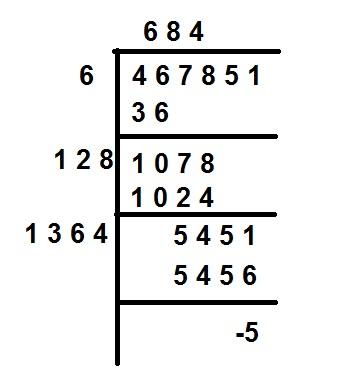
So the number should be 467856 which is
The smallest number to be added to 467851 is = 467856 - 467851 = 5







Find the smallest number that can be added to 467851 to make the sum a perfect square.
Given:
Given number = 467851
Solution:
Long division method:
So the number should be 467856 which is
The smallest number to be added to 467851 is = 467856 - 467851 = 5
 English
 100 Questions
 100 Marks
 90 Mins English English100 Questions100 Marks90 Mins English English100 Questions100 Marks90 Mins English
The product of two consecutive positive multiples of 5 is 750. What is the smaller of the two numbers?
The product of two consecutive even numbers is 624. What is the sum of the two numbers?
The sum of the squares of two positive integers is 1025 and difference of their squares is 225 . The difference of the numbers is what percent of the product of these numbers ?
If then how many positive factors does N have ?
When is written in decimal notation, then the sum of digits will be
The sum of five consecutive multiples of 8 is 560. The smallest multiple is
A two-digit number is 4 times the sum of its digits and twice the product of the digits. The number is:
The product of the predecessor of 201 and the successor of 4781 is:
The number of positive prime integer <50 is


Suggested Test Series

Suggested Test Series
The product of two consecutive positive multiples of 5 is 750. What is the smaller of the two numbers?
The product of two consecutive even numbers is 624. What is the sum of the two numbers?
The sum of the squares of two positive integers is 1025 and difference of their squares is 225 . The difference of the numbers is what percent of the product of these numbers ?
If then how many positive factors does N have ?
When is written in decimal notation, then the sum of digits will be
The sum of five consecutive multiples of 8 is 560. The smallest multiple is
A two-digit number is 4 times the sum of its digits and twice the product of the digits. The number is:
The product of the predecessor of 201 and the successor of 4781 is:
The number of positive prime integer <50 is
