






Correct option is A
The buoyancy force per unit mass can be calculated using the formula:
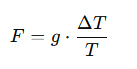
Where:
· g = acceleration due to gravity (9.8 m/s2)
· ΔT = temperature difference (Tparcel −Tenvironment)
· T = temperature of the environment in Kelvin
Step 1: Convert temperatures to Kelvin
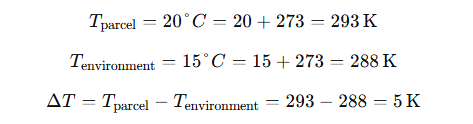
Step 2: Apply the formula
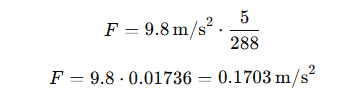
Final Answer:
The buoyancy force acting on the air parcel is approximately 0.17 m/s².
Information Booster: 1. Buoyancy in the atmosphere:
· Buoyancy force arises when an air parcel has a different density (or temperature) compared to the surrounding air.
2. Temperature and buoyancy:
· Warmer air is less dense, so it rises, creating an upward buoyancy force.
· Colder air is denser and sinks.
3. Role of Kelvin scale:
· Temperature differences are calculated in Kelvin to avoid negative values.
4. Application:
· Buoyancy calculations are critical in meteorology to study convection, cloud formation, and atmospheric instability.
Additional Knowledge: 1. F=g⋅ΔT/T: This formula assumes a linear relationship between temperature and density.
2. Troposphere characteristics:
· The troposphere is the lowest layer of the atmosphere, where most weather phenomena occur.
3. Factors influencing buoyancy:
· Temperature difference
· Gravity
· Environmental lapse rate
 English
 10 Questions
 20 Marks
 12 Mins


