hamburger menu
All Coursesall course arrow
adda247
reward-icon
adda247
    arrow
    arrow
    arrow
    ​Epistasis is observed between different genes in flower color of sweet pea. A red variety on selfing yields a red:white ratio of 9:7. The precursors
    Question

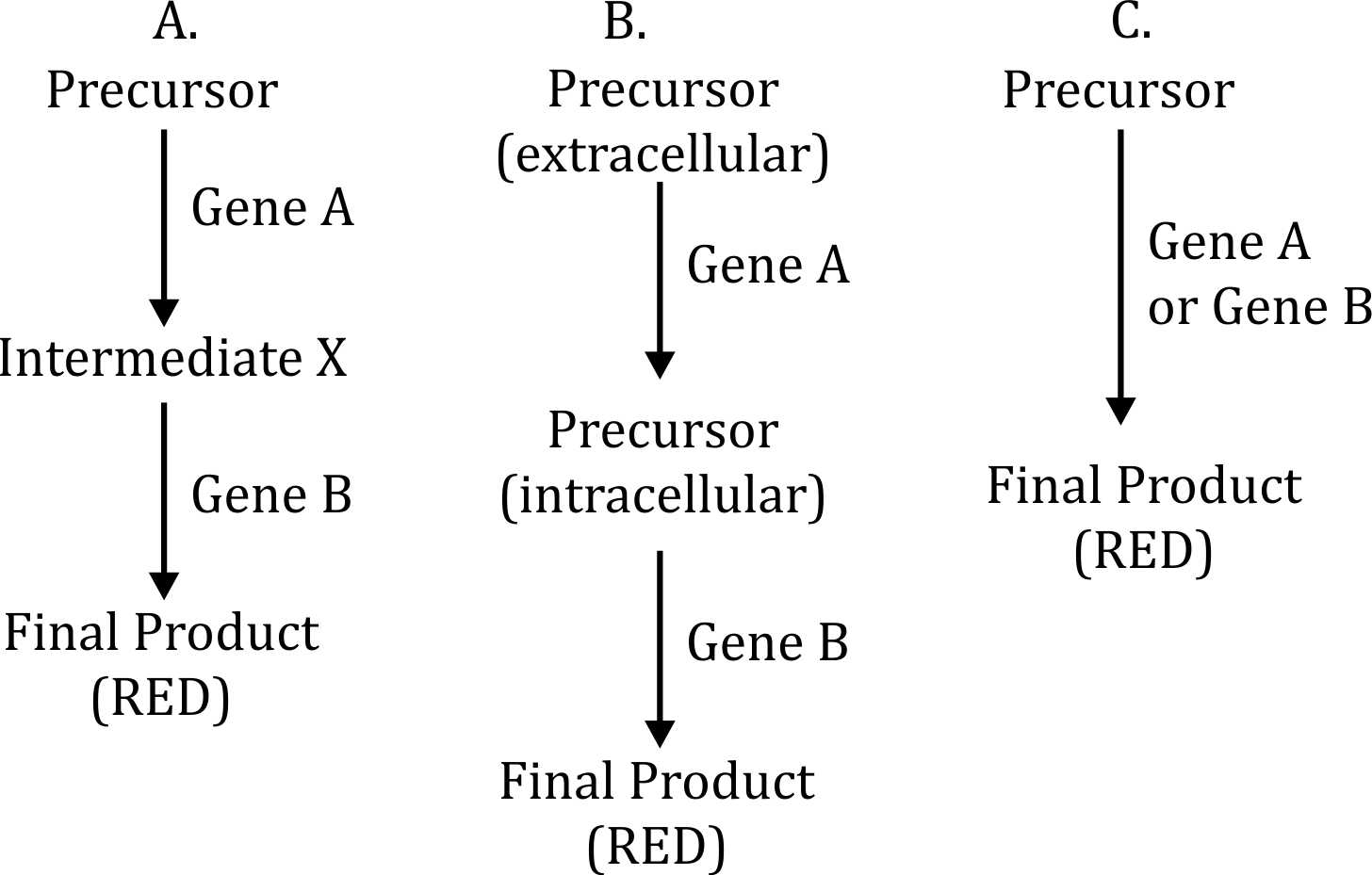
    Epistasis is observed between different genes in flower color of sweet pea. A red variety on selfing yields a red:white ratio of 9:7. The precursors and intermediates give a white color. The following biochemical pathways were proposed for these observations:

    Which one of the options represents the correct pathway(s) that explains the observations?

    A.

    ​A only

    B.

    ​Both A and B

    C.

    ​Both B and C

    D.

    A, B, and C

    Correct option is B

    Explanation:

    The observed 9:7 ratio in the flower color inheritance suggests duplicate recessive epistasis (also called complementary gene action). This means both genes (A and B) must be functional to produce the red pigment, and if either one is missing (aa or bb), the result is a white flower.

    Analysis of Pathways:

    • Pathway A:
      • The precursor is converted by Gene A into Intermediate X.
      • Intermediate X is further converted by Gene B into the red pigment.
      • If either Gene A or Gene B is missing, the pathway stops, and the flower remains white.
      • This fits the 9:7 ratio, meaning it is a valid pathway.
    • Pathway B:
      • Similar to Pathway A, but it introduces extracellular and intracellular precursors before Gene B acts.
      • The essential requirement of both Gene A and Gene B remains the same, making it consistent with the 9:7 epistasis pattern.
      • This also explains the observed inheritance, meaning it is valid.
    • Pathway C:
      • It suggests that either Gene A or Gene B alone can produce the red pigment, meaning only one dominant allele would be required.
      • This would not result in a 9:7 ratio; instead, it would lead to a different genetic pattern (e.g., a 15:1 ratio in case of duplicate dominant epistasis).
      • Thus, Pathway C does not fit the observations and is incorrect.

    Thus, both Pathways A and B explain the observations, but Pathway C does not.
    Similar Questions

    test-prime-package

    Access ‘CSIR NET Life Sciences’ Mock Tests with

    • 60000+ Mocks and Previous Year Papers
    • Unlimited Re-Attempts
    • Personalised Report Card
    • 500% Refund on Final Selection
    • Largest Community
    students-icon
    354k+ students have already unlocked exclusive benefits with Test Prime!
    test-prime-package

    Access ‘CSIR NET Life Sciences’ Mock Tests with

    • 60000+ Mocks and Previous Year Papers
    • Unlimited Re-Attempts
    • Personalised Report Card
    • 500% Refund on Final Selection
    • Largest Community
    students-icon
    354k+ students have already unlocked exclusive benefits with Test Prime!
    Our Plans
    Monthsup-arrow