Correct option is D
I=tQFor a source being charged:V=E+IRSolution:Given:∙ Charge, Q=240C∙ Time, t=1minute=60s∙ Source voltage, E=200V∙ Resistance, R=10ΩCurrent:I=60240=4ATerminal voltage:V=200+(4×10)V=200+40V=240V

Determine the value of voltage if a charge of 240 C is delivered to a 200 V source in 1 minute with a resistance of 10 Ω.
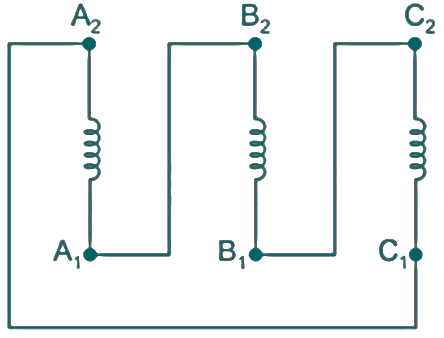
Identify the type of circuit in the image given below.
Which of the following has Henry as their SI unit?
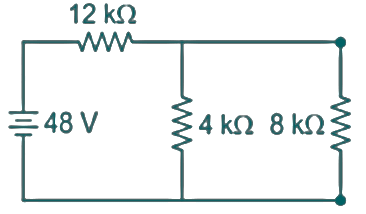
Calculate the current through 4 ΚΩ.
If two resistances of 8 2 are joined in parallel, find the equivalent resistance of the system.
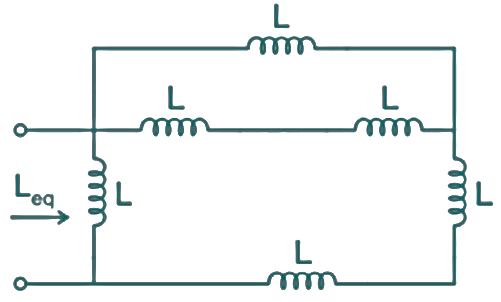
Consider the image given below. According to the image, find out the value of Leg if L is 22 mH.
Which of the following category of resistances comprises resistors in the range 1 2 to 0.1 ΜΩ?
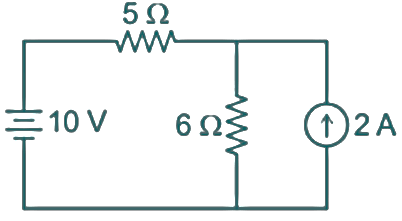
Calculate the sum of branches and nodes in the circuit shown below.
Determine the value of voltage if a charge of 240 C is delivered to a 200 V source in 1 minute with a resistance of 10 Ω.
In an electrical circuit, a voltage difference of 18 V is applied through a set of resistances R1, R2, and R3. Here, R₁ (6Ω) is in series with R2 (12 Ω) and there combination is in parallel with R3 6 Ω. Calculate the total current in the circuit.
Consider a 390 V, 50 Hz circuit. This inductive circuit has a current of 13 A, lagging 30 degrees. Find the inductive reactance.


Identify the type of circuit in the image given below.
Which of the following has Henry as their SI unit?
Calculate the current through 4 ΚΩ.
If two resistances of 8 2 are joined in parallel, find the equivalent resistance of the system.
Consider the image given below. According to the image, find out the value of Leg if L is 22 mH.
Which of the following category of resistances comprises resistors in the range 1 2 to 0.1 ΜΩ?
Calculate the sum of branches and nodes in the circuit shown below.
Determine the value of voltage if a charge of 240 C is delivered to a 200 V source in 1 minute with a resistance of 10 Ω.
In an electrical circuit, a voltage difference of 18 V is applied through a set of resistances R1, R2, and R3. Here, R₁ (6Ω) is in series with R2 (12 Ω) and there combination is in parallel with R3 6 Ω. Calculate the total current in the circuit.
Consider a 390 V, 50 Hz circuit. This inductive circuit has a current of 13 A, lagging 30 degrees. Find the inductive reactance.
