






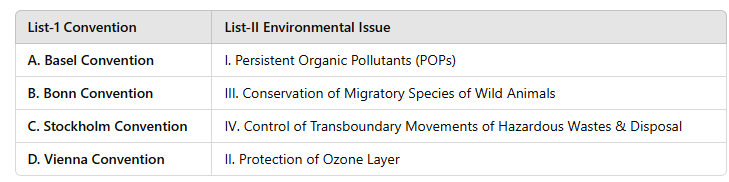
Correct option is C
Basel Convention (A-IV):
· Addresses the Control of Transboundary Movements of Hazardous Wastes and Their Disposal. Adopted in 1989, it aims to prevent the illegal trafficking of hazardous waste.
Bonn Convention (B-III):
· Focuses on the Conservation of Migratory Species of Wild Animals. It was signed in 1979 to protect migratory species that cross international boundaries.
Stockholm Convention (C-I):
· Concerns Persistent Organic Pollutants (POPs). Adopted in 2001, it aims to eliminate or restrict the production and use of POPs due to their environmental and health hazards.
Vienna Convention (D-II):
· Deals with the Protection of the Ozone Layer. Adopted in 1985, it laid the groundwork for the Montreal Protocol, addressing substances that deplete the ozone layer.
Information Booster:
1.
Basel Convention:
· Focuses on hazardous waste movement between countries.
· Prevents the dumping of hazardous waste in less developed nations.
2.
Bonn Convention:
· Also known as
CMS (Convention on Migratory Species).
· Encourages international cooperation to protect migratory wildlife.
3.
Stockholm Convention:
· Targets chemicals like
DDT, PCBs, and dioxins known for their persistence in the environment.
4.
Vienna Convention:
· Paved the way for the
Montreal Protocol, which reduced the use of
CFCs (Chlorofluorocarbons).
Additional Knowledge:
·
Persistent Organic Pollutants (POPs):
· Toxic chemicals that resist degradation, bioaccumulate, and pose risks to human health.
·
Ozone Layer Protection:
· Essential to block harmful UV radiation.
· The
Montreal Protocol has significantly reduced ozone-depleting substances.
·
Migratory Species Conservation:
· Migratory species rely on multiple habitats across international boundaries, necessitating global cooperation.
·
Hazardous Waste:
· Includes chemicals, medical waste, and industrial byproducts harmful to health and the environment.
 English
 10 Questions
 20 Marks
 12 Mins


