






Correct option is A
1.
Conflict-Serializability: This concept examines if the transactions in a schedule can be reordered to match a serial execution. Conflict serializability relies on detecting cycles in a precedence graph.
2.
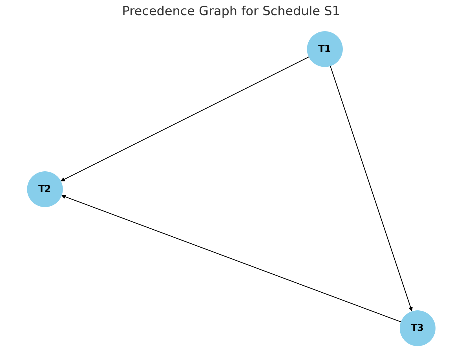
Analyzing S1: By constructing a precedence graph for S1, we find no cycles, meaning it can be rearranged into a serial order, thus it is conflict-serializable.
3.
Analyzing S2: For S2, a precedence graph reveals cycles, implying it cannot be rearranged into a conflict-serializable schedule.
Information Booster:
·
Conflict Serializability: Ensures that even with concurrent execution, the result is as if the transactions ran in a specific serial order.
·
Precedence Graph: A directed graph used to determine conflict-serializability by depicting dependencies among transactions.
Here is the precedence graph for Schedule S1, illustrating the conflict relationships among transactions T1, T2 and T3. Each directed edge represents a conflict dependency, indicating that one transaction’s action affects another, leading to a precedence constraint.
 English
 10 Questions
 20 Marks
 12 Mins


