






Correct option is A
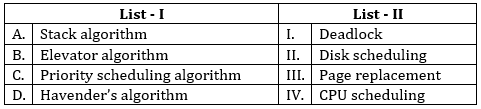
The correct matching of the given algorithms and their applications is as follows:
1.
Stack Algorithm: It is associated with
Page Replacement. The Stack Algorithm is used in memory management systems to determine which page to replace when a page fault occurs.
2.
Elevator Algorithm: This is related to
Disk Scheduling. The Elevator Algorithm optimizes the movement of the read/write head on a disk drive, mimicking the behavior of an elevator.
3.
Priority Scheduling Algorithm: It is a method of
CPU Scheduling. In this algorithm, processes are assigned priorities, and the process with the highest priority is executed first.
4.
Havender’s Algorithm: It is associated with
Deadlock prevention or avoidance. Havender’s Algorithm provides methods for ensuring that a system does not enter a deadlock state.
Thus, the matching aligns with
(a) A-III, B-II, C-IV, D-I.
Information Booster:
1.
Stack Algorithm:
· A page replacement algorithm often used in operating systems.
· Determines the least recently used (LRU) or optimal page replacement.
· Common in scenarios requiring efficient memory management.
2.
Elevator Algorithm:
· Also known as SCAN Algorithm.
· Moves the disk arm back and forth, serving requests in the direction of the current movement.
· Reduces the seek time for disk scheduling.
3.
Priority Scheduling Algorithm:
· A preemptive or non-preemptive scheduling algorithm.
· Can lead to
starvation, which can be mitigated using
aging.
4.
Havender’s Algorithm:
· Addresses circular wait conditions in deadlocks.
· Implements resource allocation graphs to avoid cyclic dependencies.
Additional Knowledge:
·
Page Replacement:
· Algorithms like FIFO, LRU, and Optimal fall under this category.
· Helps in determining which memory page to swap out during a page fault.
·
Disk Scheduling: Includes other algorithms like FCFS, SSTF, and C-SCAN.
·
CPU Scheduling: Includes algorithms like Round Robin, SJF, and Multilevel Queue Scheduling.
·
Deadlock Avoidance: Techniques include Banker’s Algorithm and safe state checks.
 English
 10 Questions
 20 Marks
 12 Mins


