hamburger menu
All Coursesall course arrow
adda247
reward-icon
adda247
    arrow
    arrow
    arrow
    Consider a petrol pump which has a single petrol dispensing unit. Customers arrive there inaccordance with a Poisson process having rate λ=1 &nbs
    Question

    Consider a petrol pump which has a single petrol dispensing unit. Customers arrive there in

    accordance with a Poisson process having rate λ=1  minutes. An arriving customer enters the petrol pump only if there are two or less customers in the petrol pump, otherwise he/she leaves the petrol pump without taking the petrol (at any point of time a maximum of three customers are present in the petrol pump). Successive service times of the petrol dispensing unit are independent exponential random variables having mean 1/2 minutes. Let X denote the average number of customers in the petrol pump in the long run. Then E(X) is equal to

    A.

    7/15

    B.

    3/5

    C.

    11/15

    D.

    13/15

    Correct option is C

    Concept:

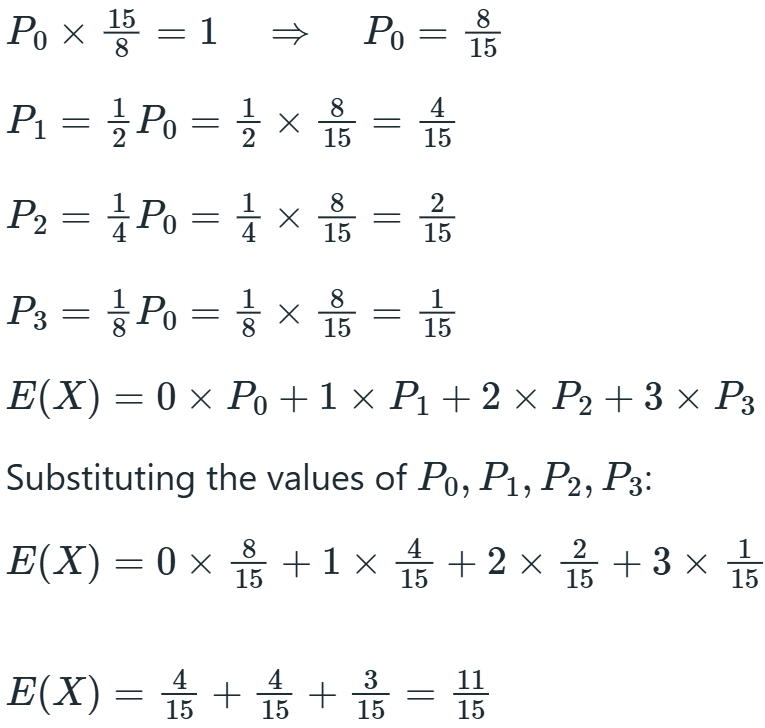
    The value of  E(X)=0×P0+1×P1+2×P2+3×P3

    Solution:

    we have,

    A single server (the petrol dispensing unit),

    Customers arrive according to a Poisson process with rate λ=1 per minute,

    Service times are exponentially distributed with mean 12 minutes (service rate μ=2),

    The petrol pump has a maximum capacity of 3 customers (only 3 customers can be in the

    system, including the one being served). If there are already 3 customers, new arrivals are

    blocked (they leave without entering the system).

    This describes an M/M/1/3 queueing system with arrival rate  λ=1, service rate μ=2, and

    a system capacity of 3 (maximum 3 customers).

    Let the state X denote the number of customers in the petrol pump (0, 1, 2, or 3). The system has

    a finite capacity, so the maximum number of customers at any given time is 3.

    The system is modeled as a birth-death process with the following transition rates:

    Arrival rate λ=1 ,

    Service rate μ=2.

    Let Pn be the steady-state probability that there are n customers in the system. We need to find

    P0P1,P2,P3 the probabilities for 0, 1, 2, and 3 customers in the system.

    Using the birth-death process relations, we get

    Thus,

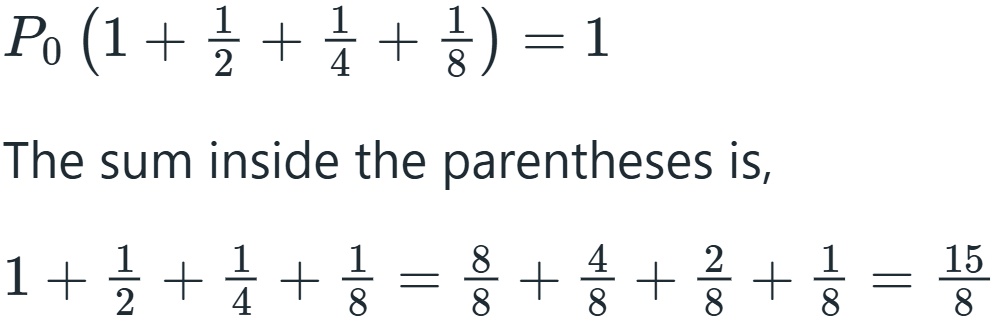
    Now, since the total probability must sum to 1,

    P0+ P1+ P2+ P3= 1

    Substituting the values of P1,P2,P3 in terms of P0:

    Factoring out P0,

    Hence correct option is (c).
    Similar Questions

    test-prime-package

    Access ‘CSIR NET- GENERAL APTITUDE’ Mock Tests with

    • 60000+ Mocks and Previous Year Papers
    • Unlimited Re-Attempts
    • Personalised Report Card
    • 500% Refund on Final Selection
    • Largest Community
    students-icon
    354k+ students have already unlocked exclusive benefits with Test Prime!
    test-prime-package

    Access ‘CSIR NET- GENERAL APTITUDE’ Mock Tests with

    • 60000+ Mocks and Previous Year Papers
    • Unlimited Re-Attempts
    • Personalised Report Card
    • 500% Refund on Final Selection
    • Largest Community
    students-icon
    354k+ students have already unlocked exclusive benefits with Test Prime!
    Our Plans
    Monthsup-arrow