






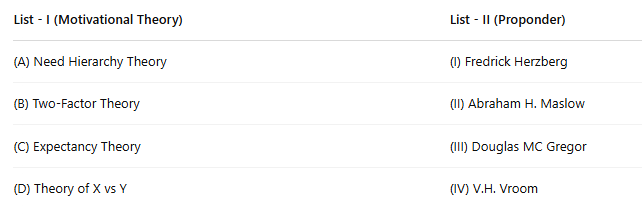
Correct option is D
Each theory mentioned here is a cornerstone in motivational psychology and management studies:
Abraham Maslow developed the Need Hierarchy Theory, which suggests that human needs are arranged in a five-level pyramid, ranging from basic physiological needs to self-actualization.
Fredrick Herzberg introduced the Two-Factor Theory, distinguishing between hygiene factors (which prevent dissatisfaction) and motivators (which drive satisfaction).
Victor H. Vroom proposed the Expectancy Theory, which emphasizes the mental processes regarding choice and motivation, stating that individuals are motivated when they believe their efforts will lead to desirable outcomes.
Douglas McGregor introduced the Theory X and Theory Y, representing two contrasting models of workforce motivation and management styles—Theory X assumes people dislike work, whereas Theory Y assumes people are self-motivated and thrive on responsibility.
Information Booster:
Need Hierarchy Theory (Maslow):
Five levels: Physiological, Safety, Social, Esteem, and Self-actualization.
Needs must be satisfied in order.
Foundation of modern HR practices.
Two-Factor Theory (Herzberg):
- Hygiene factors (e.g., salary, work conditions) prevent dissatisfaction.
Motivators (e.g., recognition, achievement) encourage satisfaction.
Emphasizes job enrichment.
Expectancy Theory (Vroom):
Motivation = Expectancy × Instrumentality × Valence.
Based on belief, reward, and value of the outcome.
Widely used in goal-setting and performance appraisal.
Theory of X vs Y (McGregor):
Theory X: Authoritarian style, assumes employees dislike work.
Theory Y: Participative style, assumes people seek responsibility.
Encourages participative management in modern organizations.
 English
 10 Questions
 20 Marks
 12 Mins


