






Correct option is D
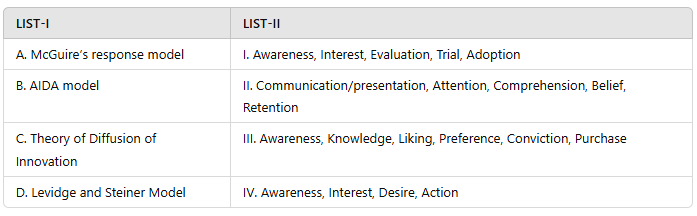
Understanding the models of integrated communication is essential in marketing, advertising, and public relations. These models help explain how consumers process information and make purchasing decisions. The correct matching is:
McGuire’s Response Model → Communication/presentation, Attention, Comprehension, Belief, Retention (II)
McGuire’s Communication/Persuasion Matrix explains how individuals process messages through sequential stages: presentation, attention, comprehension, yielding (belief formation), and retention. This model focuses on how communication influences an audience’s cognitive and emotional responses.AIDA Model → Awareness, Interest, Desire, Action (IV)
The AIDA (Attention, Interest, Desire, Action) model is one of the most widely used models in marketing communication. It describes how advertisements or marketing strategies move a consumer from initial awareness to making a purchase decision.Theory of Diffusion of Innovation → Awareness, Interest, Evaluation, Trial, Adoption (I)
Developed by Everett Rogers, this theory explains how new ideas, technologies, or products spread through a population. The process follows five stages: Awareness, Interest, Evaluation, Trial, and Adoption, showing how individuals or groups decide to adopt an innovation over time.Lavidge and Steiner Model → Awareness, Knowledge, Liking, Preference, Conviction, Purchase (III)
This model represents a hierarchical approach to consumer decision-making, progressing from awareness to action (purchase). It expands on AIDA by adding intermediate steps such as knowledge, liking, preference, and conviction, highlighting the importance of gradual persuasion.
Information Booster:
McGuire’s Model
Focuses on stages of persuasion and cognitive processing.
Used in advertising, public relations, and educational communication.
Helps marketers understand how audiences retain and believe messages.
AIDA Model
Used in advertising and sales strategies.
Helps in structuring advertisements for maximum consumer impact.
Encourages marketers to build awareness, sustain interest, create desire, and prompt action.
Theory of Diffusion of Innovation
Explains why some innovations succeed while others fail.
Identifies different adopter categories: Innovators, Early Adopters, Early Majority, Late Majority, Laggards.
Used in product launches, technology adoption, and social change.
Lavidge and Steiner Model
Suggests that consumer purchasing is a gradual process.
Emphasizes knowledge-building and emotional connections before action.
Commonly applied in brand marketing and advertising campaigns.
 English
 10 Questions
 20 Marks
 12 Mins


