






Correct option is C
To find the
equivalent continuous noise level (Leq), we use the following formula for combining varying noise levels:
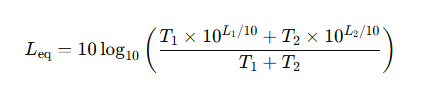
Where:
· L1=90 dBA (Noise level for 10 minutes)
· L2 =70 dBA (Noise level for 40 minutes)
· T1=10 minutes
· T2=40 minutes
Step-by-Step Calculation:
1. Convert each noise level to its energy equivalent:

2. Plug into the formula:
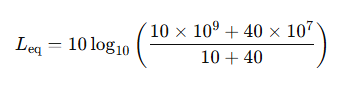
3. Simplify the terms:
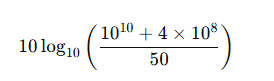
4. Calculate the logarithm:
Leq≈83 dBA
Thus, the equivalent continuous noise level is ~83 dBA.
Thus, the equivalent continuous noise level is
~83 dBA.
Explanation:
·
90 dBA for 10 minutes represents a high noise level.
·
70 dBA for 40 minutes is significantly lower.
· The
Leq represents an average noise level over the 50-minute period, factoring in the higher energy contribution of the 90 dBA segment.
Information Booster:
1.
Leq (Equivalent Continuous Sound Level) averages fluctuating noise levels over time.
2. Noise levels are measured in
decibels (dBA), a logarithmic unit.
3.
Higher decibel levels contribute exponentially more energy.
4.
Short high-noise events can significantly raise the average Leq.
5. Leq helps assess noise exposure for environmental and occupational safety.
6.
Noise control regulations use Leq to determine permissible limits.
Additional Knowledge:
·
(a) ~32 dBA:
· Unlikely given the higher noise contributions.
· Represents a much lower noise level than calculated.
·
(b) ~64 dBA:
· Too low considering the 90 dBA exposure.
· Doesn’t account for the high-energy noise segment.
·
(c) ~83 dBA:
· Correct calculation based on noise energy contributions.
· Reflects the average of
90 dBA and 70 dBA exposures.
·
(d) -160 dBA:
· Not a valid noise level.
· Negative decibel levels are not realistic in practical measurements.
Key Points:
1.
Leq is crucial for evaluating cumulative noise exposure.
2.
Higher dBA values impact the overall average significantly.
3.
Occupational safety standards set limits on permissible noise levels.
4. Noise exposure is mitigated through protective measures and noise control strategies.
 English
 10 Questions
 20 Marks
 12 Mins


