Correct option is A
Explanation:
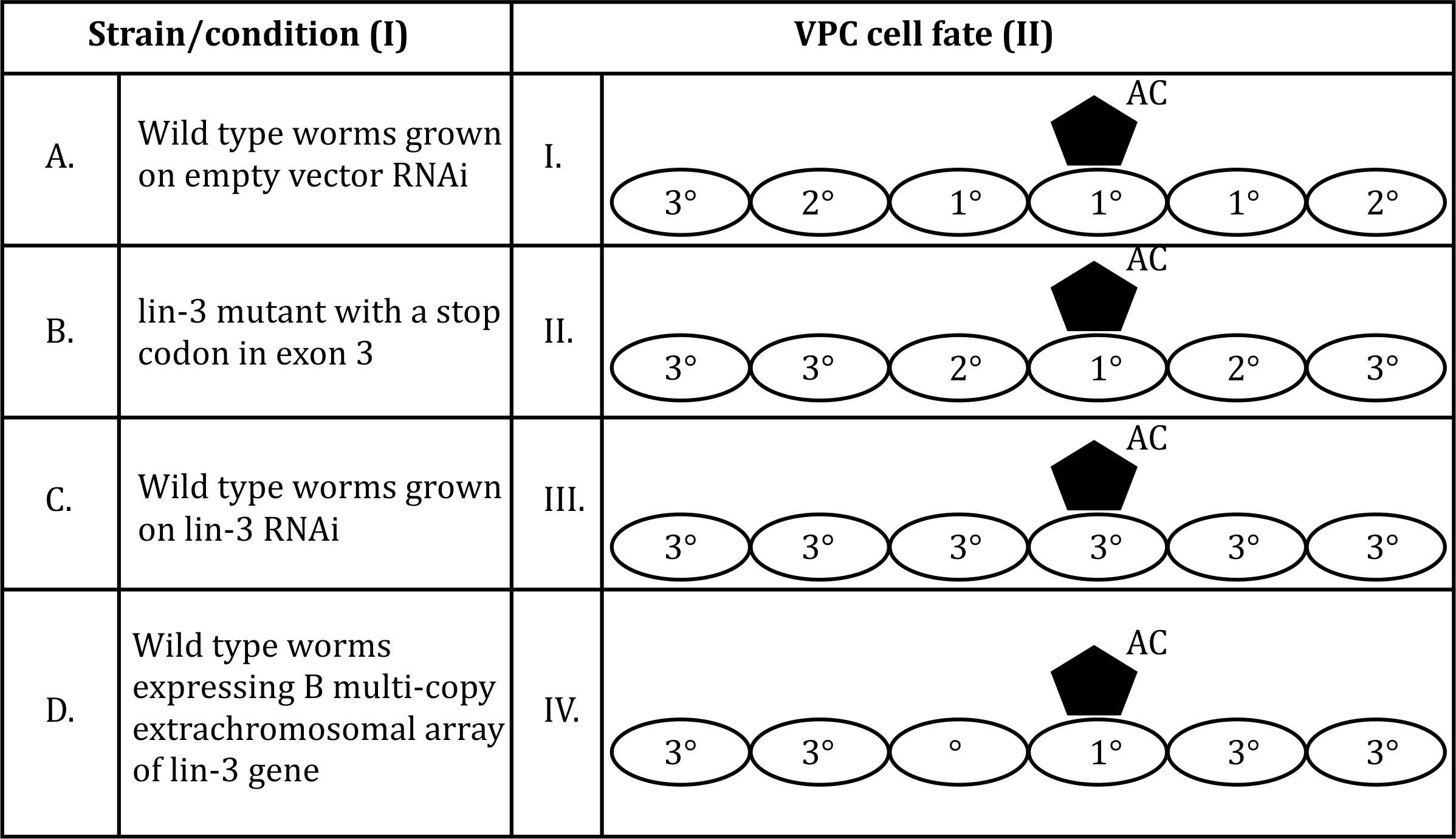
1. Wild-type worms grown on empty vector RNAi (A →ii)
- Normal LIN-3 levels.
- Standard vulval development pattern:
(3° - 2° - 1° - 2° - 3°). - Corresponds to VPC fate I.
2. lin-3 mutant with a stop codon in exon 3 (B → iii)
- No functional LIN-3 protein → No vulval induction.
- All VPCs adopt 3° fate (remain as epidermal cells).
- Corresponds to VPC fate III (Vulvaless phenotype).
3. Wild-type worms grown on lin-3 RNAi (C → iv)
- Reduced LIN-3 levels.
- Insufficient LIN-3 to trigger normal differentiation.
- Most VPCs remain 3° fate → Similar to LIN-3 knockout.
- Corresponds to VPC fate IV.
4. Wild-type worms expressing a multi-copy extrachromosomal array of lin-3 gene (D → i)
- Excess LIN-3 expression → Stronger induction.
- More VPCs adopt 1° and 2° fates → Extra vulval formation.
- Corresponds to VPC fate II.
Information Booster:
Condition A - In wild-type C. elegans grown on empty vector RNAi, there is no knockdown or mutation affecting LIN-3 expression, meaning LIN-3 is present at normal physiological levels. This results in the standard pattern of vulval precursor cell (VPC) differentiation.
Condition B - If C. elegans carries a lin-3 mutant with a stop codon in exon 3, it means LIN-3 protein will not be produced due to premature translation termination. As a result, there will be no LIN-3 signaling from the anchor cell (AC), leading to a failure in vulval precursor cell (VPC) induction.
Condition C- When wild-type C. elegans worms are treated with LIN-3 RNAi, the expression of LIN-3 is significantly reduced due to RNA interference. This leads to a decrease in LIN-3 signaling from the anchor cell (AC), which affects vulval precursor cell (VPC) differentiation.Since RNAi decreases LIN-3 levels, VPCs do not receive sufficient signaling to differentiate properly. most VPCs remain undifferentiated as 3° cells, forming epidermal tissue instead of vulval cells .
Condition D - If wild-type C. elegans overexpress LIN-3 using a multi-copy extrachromosomal array,the levels of LIN-3 increase significantly. This leads to stronger signaling from the anchor cell (AC), which affects vulval precursor cell (VPC) differentiation. more VPCs adopt 1° and 2° fates, leading to excess vulval formation (Muv phenotype).