Correct option is D
Explanation:
The Bicoid (bcd) gene in Drosophila melanogaster is a maternal effect gene that acts as a morphogen, meaning it forms a concentration gradient that determines head formation in the developing embryo. The highest Bicoid concentration leads to the development of anterior structures (head and thorax), while the absence of Bicoid results in posterior structures (tail).
If bcd is missing (bcd⁻ mutants), embryos fail to develop a head, confirming its essential role in anterior development.
Analysis of the Experimental Setups:
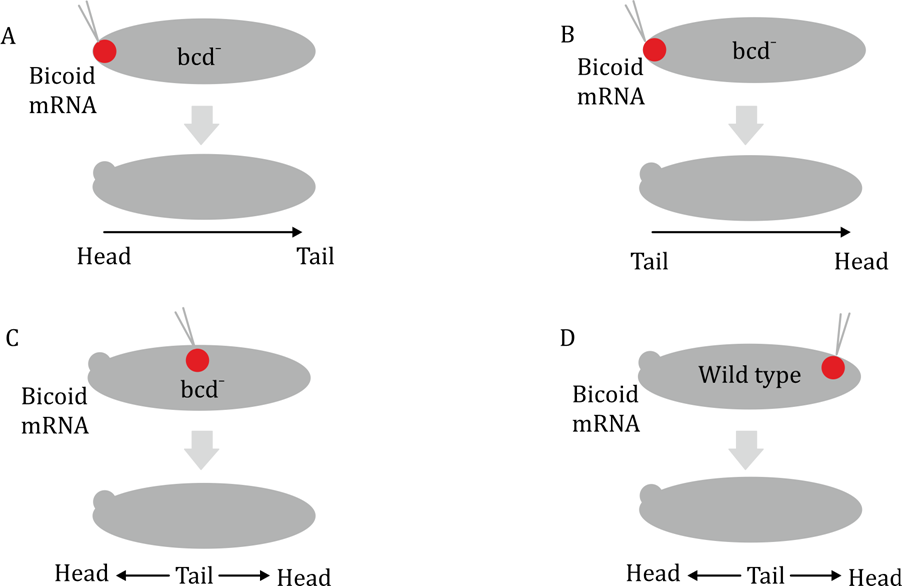
Each setup involves injecting bicoid mRNA at different locations in bcd⁻ mutant or wild-type embryos, and observing how the embryo develops.
A. Injection of bicoid mRNA at the anterior in a bcd⁻ mutant → Normal Head-Tail Pattern (Correct)
Injected at the anterior (normal position) in a bcd⁻ embryo.
The embryo forms a normal head at the anterior end and a tail at the posterior end.
This confirms that placing bicoid in its correct location rescues normal development.
B. Injection of bicoid mRNA at the posterior in a bcd⁻ mutant → Head Forms at Posterior (Incorrect)
Injected at the posterior end in a bcd⁻ mutant.
The embryo develops a tail at the original anterior and a head at the posterior end.
This setup reverses the normal polarity, which is not the expected correct developmental pattern.
C. Injection of bicoid mRNA at the middle of a bcd⁻ mutant → Two Heads Form (Incorrect)
Injected at the middle of a bcd⁻ mutant.
Two heads form—one at the original anterior and another at the middle where bicoid was injected.
While this demonstrates that Bicoid is sufficient to induce head formation, this is not the normal developmental pattern expected in a properly organized embryo.
D. Wild-type embryo with normal bicoid localization → Normal Head-Tail Formation (Correct)
Wild-type embryo (bcd⁺) naturally expresses Bicoid in its normal anterior position.
As expected, the embryo develops a head at the anterior and a tail at the posterior.
This is the correct, naturally occurring developmental pattern in wild-type embryos.