Correct option is D
The correct answer is (d) 3pV
Explanation:
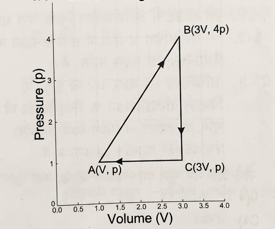
In a p–V diagram, the work done during a closed cycle is equal to the area enclosed by the cycle.
The given cycle ABCA forms a right-angled triangle with vertices:
A (V, p)
B (3V, 4p)
C (3V, p)
Step-by-step:
The base of the triangle (horizontal distance) is:
Base = 3V − V = 2VThe height of the triangle (vertical distance) is:
Height = 4p − p = 3pArea of triangle (Work done) = 1/2 × Base × Height
= 1/2 × (2V) × (3p)
= 3pV
Therefore, the net work done in the cycle = 3pV.
Information Booster:
If the cycle is clockwise, the net work done is positive.
If the cycle is anticlockwise, the net work done is negative.
Work done is a path function, meaning it depends on the specific process followed, not just the initial and final states.
Additional Knowledge:
pV (Option a) would be correct only if the base was V and the height was 2p, which is not the case here.
So, the correct answer is (d) 3pV.
 English
 25 Questions
 100 Marks
 20 Mins