Correct option is B
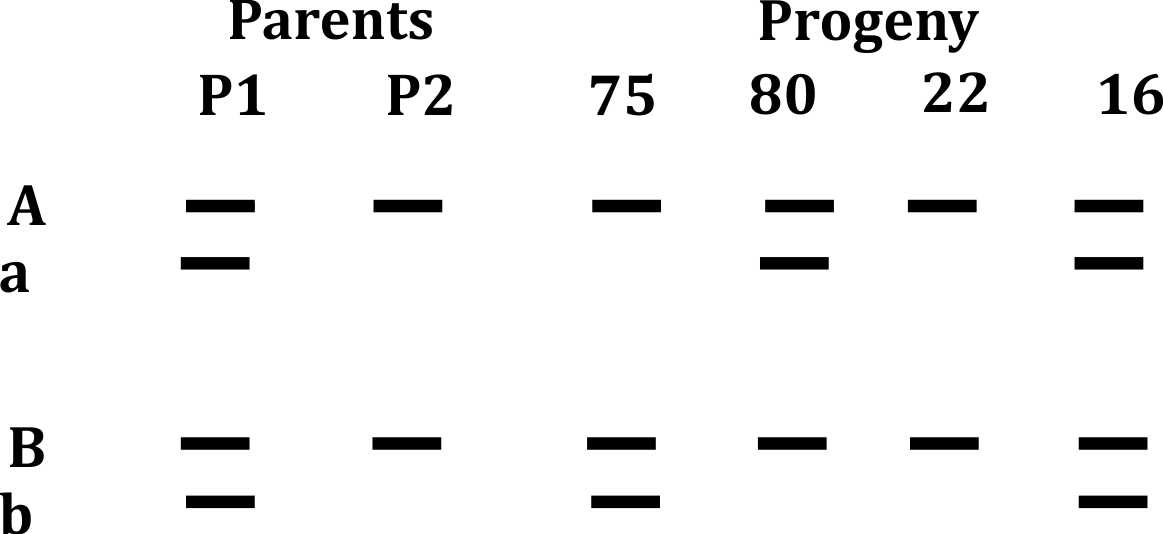
The band pattern in the gel shows that the alleles A, a, B, and b segregate in a manner that suggests the alleles are in repulsion configuration in the heterozygous parent. In repulsion, the dominant allele of one gene (such as A or B) is inherited with the recessive allele of the other gene (such as b or a). This type of arrangement leads to a different combination of alleles being inherited together compared to coupling configuration. The gel data shows a non-pairing segregation of the alleles, which supports this conclusion. Therefore, alleles A and b are inherited together, and alleles a and B are inherited together in the heterozygous parent, which is typical of repulsion.
Information Booster:
- Repulsion configuration occurs when the dominant allele of one gene is linked with the recessive allele of the other gene, such as A with b and a with B.
- In repulsion, the alleles are inherited separately in progeny, leading to more varied combinations in offspring than in coupling.
- The gel band pattern reveals that the progeny are inheriting non-parental combinations of alleles (A with b and a with B), which supports repulsion.
- In the case of linkage, repulsion can still occur, but the alleles are likely linked on the same chromosome and still follow certain inheritance patterns.
- Recombination can occur in repulsion configuration, leading to an equal distribution of parental and recombinant gametes.
- In repulsion, we often see higher recombination rates between alleles that are positioned far apart on the chromosome.
Additional Information:
- Option 1: "In the heterozygous parent, the alleles are in coupling configuration." This is incorrect because in coupling, both dominant alleles would be inherited together (A and B), and the recessive alleles (a and b) would be inherited together. However, this is not seen in the gel pattern.
- Option 3: "The alleles A and B are in different linkage groups." This is incorrect because the alleles A and B are likely on the same chromosome and show linkage. The band pattern suggests the alleles are closely linked.
- Option 4: "The information is insufficient for any conclusion." This is incorrect because the gel pattern provides sufficient data to conclude the alleles are in repulsion configuration.