Correct option is C
The cost of debt capital (Kd) is calculated using:
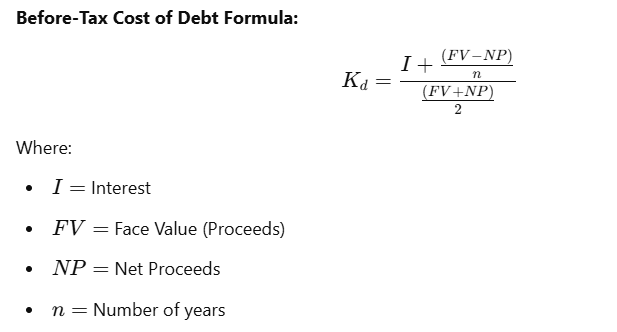
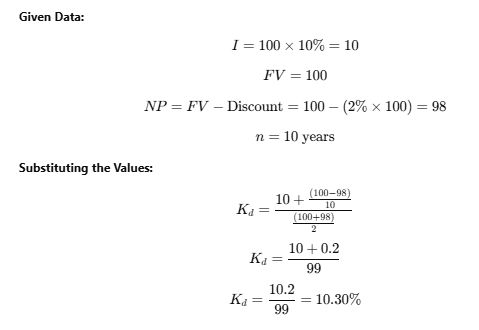
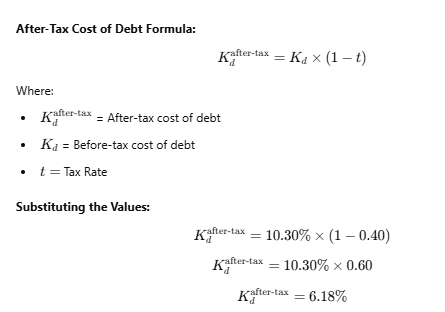
A company raises ₹1,00,000 by issuing 1000, 10% debentures of ₹100 each at a 2% discount, redeemable after 10 years. If the corporate tax rate is 40%, what is the cost of capital?
The cost of debt capital (Kd) is calculated using:



| LIST-I Concept |
LIST-II Formula |
| A. Present Value |
I. Cash flow x (1+r)⁴ |
| B. Future Value |
II. Cash flow/ (1+r)⁴ |
| C. Future Value of Annuity |
III. R (PVIFi,n) |
| D. Present Value of Annuity |
IV. R (FVIFAi,n) |
When foreign currency assets and liabilities match in terms of amount of exposure and timing of maturities, it is described as:
The portfolio theory articulates diversification to reduce which of the following risks?
Determine the P/V ratio from the following particulars.
· Total Fixed Cost = ₹12,000
· Actual Sales = ₹48,000
· Margin of Safety = ₹8,000
A proposal requires a cash outflow of ₹18,500 and is expected to generate cash inflows of ₹8,000, ₹6,000, ₹4,000, ₹2,000 and ₹2,000 over next 5 years respectively. The payback period is
Identify correct statements from the following regarding Time Value of money:
A. The interest which may be earned/saved on the money held at present underlines the concept of time value of money.
B. The money which is receivable at present has less value than the money receivable in future.
C. The relationship that exists between the value of money receivable at present and the value of money receivable in future is referred as time value of money.
D. Value of money receivable at present - value of money receivable in future - Time value of money
E. Future value of money is the value of money held presently at some given future time at a given rate of interest.
Choose the correct answer from the options given below:
Match the List I with List II
List I (Direct Material Variance) | List II (Formula) |
A. Direct material cost variance | I. Standard price × (Revised standard quantity - Actual Quantity) |
B. Direct material price variance | II. Standard price × (Standard Quantity for actual output quantity - Actual Quantity) | |
C. Direct material usage variance | III. Actual Quantity × (standard price - actual price) |
D. Direct material mix variance | IV. Standard cost for actual output - actual cost | |
Codes:
A production function expressed as:

Or

Where A>0,0 <α<1 and β>-1,
where L = labour, K = capital, A, α, and β are three parameters, is called:
. If the risk-free return (Rf) is 6%, Beta (β) is 1.5, and the market rate of return (Km) is 10%, what is the expected rate of return?
Suggested Test Series


