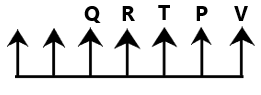
Correct option is A


Based on the English alphabetical order, three of the following four are alike in a certain way and thus form a group. Which is the one that does not belong to that group?
(Note: The odd man out is not based on the number of consonants/vowels or their position in the letter cluster)
Nikhil starts from Point A and drives 84 km towards North. He then takes a left turn, drives 80 km, turns left and drives 83 km. He then takes a left turn and drives 90 km. He takes a final right turn, drives 1 km and stops at Point P. How far (shortest distance) and towards which direction should he drive in order to reach Point A again? (All turns are 90-degree turns only, unless specified.)
Read the given statements and conclusions carefully. Assuming that the information given in the statements is true, even if it appears to be at variance with commonly known facts, decide which of the given conclusions logically follow(s) from the statements.
Statements:
Some towns are districts. No district is a state. No state is a city.
Conclusions:
(I) No town is a state.
(II) No district is a city.
Read the given statements and conclusions carefully. Assuming that the information given in the statements is true, even if it appears to be at variance with commonly known facts, decide which of the given conclusion(s) logically follow(s) from the statements.
Statements:
All phones are mobiles. No mobile is a pager. No mobile is a walkie-talkie.
Conclusions:
(I) No phone is a pager.
(II) Some walkie-talkies are pagers.
Which of the following letter-clusters should replace # and % so that the pattern and relationship followed between the letter-cluster pair on the left side of :: is the same as that on the right side of :: ?
# : MIN :: RNS : %
Suggested Test Series
Based on the English alphabetical order, three of the following four are alike in a certain way and thus form a group. Which is the one that does not belong to that group?
(Note: The odd man out is not based on the number of consonants/vowels or their position in the letter cluster)
Nikhil starts from Point A and drives 84 km towards North. He then takes a left turn, drives 80 km, turns left and drives 83 km. He then takes a left turn and drives 90 km. He takes a final right turn, drives 1 km and stops at Point P. How far (shortest distance) and towards which direction should he drive in order to reach Point A again? (All turns are 90-degree turns only, unless specified.)
Read the given statements and conclusions carefully. Assuming that the information given in the statements is true, even if it appears to be at variance with commonly known facts, decide which of the given conclusions logically follow(s) from the statements.
Statements:
Some towns are districts. No district is a state. No state is a city.
Conclusions:
(I) No town is a state.
(II) No district is a city.
Read the given statements and conclusions carefully. Assuming that the information given in the statements is true, even if it appears to be at variance with commonly known facts, decide which of the given conclusion(s) logically follow(s) from the statements.
Statements:
All phones are mobiles. No mobile is a pager. No mobile is a walkie-talkie.
Conclusions:
(I) No phone is a pager.
(II) Some walkie-talkies are pagers.
Which of the following letter-clusters should replace # and % so that the pattern and relationship followed between the letter-cluster pair on the left side of :: is the same as that on the right side of :: ?
# : MIN :: RNS : %