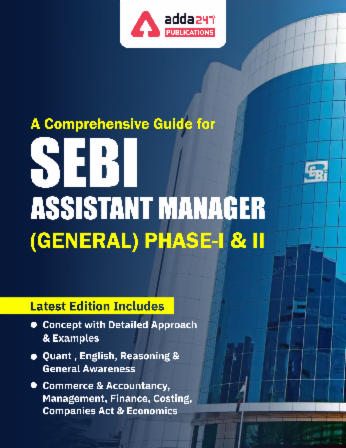
A Comprehensive Guide for SEBI Assistant Manager (General) Phase-I & II (English Medium eBook)
 112E-Books

Valid for 6 MONTH
- Never Compromise On Quality With Adda's Preparation Material
 Best In Class Material
 - Preparation Material Based On The Latest Exam Pattern Every Year
 Latest Pattern
 - Learn Anytime, Anywhere, And At Your Own Pace With Adda's E-books
 Self Paced Learning
 - Learn Across Devices, Compatible With Mobile, Tabs, And Desktops
 Device Compatibility
- Concept with Detailed Approach
- Created by Team of Experienced Bankers
- Based on Latest Pattern
 SEBI
SEBI
This Course Includes
 112 E-Books
ADDA 247 is launching A Comprehensive Guide for SEBI Assistant Manager (General) Phase-I & II & Other Banking Exams. The eBook is updated as per the latest examination pattern and is suitable for SEBI Assistant Manager & other Banking Promotion Exams.
eBooks Included
Phase-I (Paper-I)
- Reasoning Ability
- Quantitative Aptitude
- English Language
- General Awareness
Phase-I &II (Paper-II)
- Commerce & Accountancy
- Management
- Finance
- Costing
- Companies Act
- Economics
Brief index of Paper-II for SEBI Assistant Manager General Phase-I & II by Adda247 Publications.
(A) Commerce & Accountancy
- Accounting as a financial information system;
- Accounting Standards with specific reference to Accounting for Depreciation, Inventories, Revenue Recognition, Fixed Assets, Foreign Exchange Transactions, Investments.
- Cash Flow Statement, Fund flow statement, Financial statement analysis; Ratio analysis;
- Accounting for Share Capital Transactions including Bonus Shares, Right Shares.
- Employees Stock Option and Buy-Back of Securities.
- Preparation and Presentation of Company Final Accounts.
(B). Management
- Management: its nature and scope; The Management Processes; Planning, Organization, Staffing, Directing and Controlling;
- The Role of a Manager in an Organization. Leadership: The Tasks of a Leader;
- Leadership Styles; Leadership Theories; A successful Leader versus an effective Leader.
- Human Resource Development: Concept of HRD; Goals of HRD;
- Motivation, Morale and Incentives: Theories of Motivation; How Managers Motivate; Concept of Morale; Factors determining morale; Role of Incentives in Building up Morale.
- Communication: Steps in the Communication Process; Communication Channels; Oral versus Written Communication; Verbal versus non-verbal Communication; upward, downward and lateral communication; Barriers to Communication, Role of Information Technology.
(C). Finance
1) Financial System
a) Role and Functions of Regulatory bodies in Financial Sector.
2) Financial Markets
a) Primary and Secondary Markets (Forex, Money, Bond, Equity, etc.), functions, instruments, recent developments.
3) General Topics
- Basics of Derivatives: Forward, Futures and Swap
- Recent Developments in the Financial Sector
- Financial Inclusion- use of technology
- Alternate source of finance, private and social cost-benefit, Public-Private Partnership
- Direct and Indirect taxes; Non-tax sources of Revenue, GST, Finance Commission, Fiscal Policy, Fiscal Responsibility and Budget Management Act (FRBM),
- Inflation: Definition, trends, estimates, consequences, and remedies (control): WPI, CPI - components and trends.
(D). Costing
1. Overview of Cost and Management Accounting - Introduction to Cost and Management Accounting, Objectives and Scope of Cost and Management Accounting.
2. Methods of Costing - Single Output/ Unit Costing, Job Costing, Batch Costing, Contract Costing, Process/ Operation Costing, Costing of Service Sectors.
3. Basics of Cost Control and Analysis - (i) Standard Costing, (ii) Marginal Costing, (iii) Budget and Budgetary Control.
4. Lean System and Innovation:
- Introduction to Lean System
- Just-in-Time (JIT)
- Kaizen Costing
- 5 Ss
- Total Productive Maintenance (TPM)
- Cellular Manufacturing/ One-Piece Flow Production Systems
- Six Sigma (SS)
- Introduction to Process Innovation and Business Process Re-engineering (BPR).
(E). Companies Act
The Companies Act, 2013 – Specific reference to Chapter III, Chapter IV, Chapter VIII, Chapter X, Chapter XI, Chapter XII and Chapter XXVII.
(F). Economics
- Demand and Supply, Market Structures, National Income: Concepts and Measurement, Classical & Keynesian Approach Determination of output and employment, Consumption Function, Investment Function, Multiplier and Accelerator, Demand and Supply for Money , IS – LM, Inflation and Phillips Curve, Business Cycles
- Balance of Payments, Foreign Exchange Markets, Inflation, Monetary and Fiscal Policy, Non-banking Financial Institutions.


Valid for 6 MONTH